Tuesday, November 11, 2008

Sanctuary city for all?

Illegal immigration is a hotly contested issue that ignites a variety of opinions, however due to worries about the economy, Iraq, and other problems facing America, it was largely ignored during the campaign. As we were thinking about possible topics for the blog, we came across a YouTube video (http://www.youtube.com/watch?v=rdwD1x8MZ6c) and a corresponding article (http://www.sfgate.com/cgi-bin/article.cgi?f=/g/a/2008/07/16/cstillwell.DTL) about illegal immigration. The article and video focused on the establishment of San Francisco as a sanctuary city, in which illegal aliens are welcomed into the city. San Francisco launched an $83,000 outreach campaign directed at undocumented workers involving public service announcements, and education in schools, clinics, and police departments. The mayor and other public officials feel that the federal government is too strict in its enforcement of immigration laws. San Francisco will not direct funds to the enforcement of federal immigration laws and does not allow city employees, including police officers, to inquire about immigration status. The city refuses to turn over illegal immigrants to the federal government for deportation.


While it may seem like San Francisco’s compassionate policy towards illegal immigrants promotes acceptance, it can also have many negative consequences on the community. The city has experienced an increase in gang violence and violent crimes. The influx of illegal immigrants is causing an overload on the public services of the city and surrounding areas. The school systems, clinics, and other government agencies are forced to support more people without an increase in funding from tax dollars.


Is this policy really worth the side effects that come along with the benefits of promoting acceptance and compassion? Should San Francisco have the right to disregard federal law and create their own policies, regardless of the effects that their decisions will have on the surrounding community? Is it unfair to the legal immigrants and taxpayers that are supporting this illegal activity?

Monday, November 10, 2008

Raise Awareness!

As I sat here and tried to think of something to write, I took a look at my laptop. It's nothing extraordinary, but it is covered in stickers and draws one's eye. There are about three Obama/Biden '08 circles, a couple of exhortations to Make Trade Fair, the gay rights equals sign, along with other images. This laptop is a monument to good causes, a vivid showing of good will.

What does it really mean that I have these causes, stances, and symbols displayed on my laptop? Am I really doing anything to better the world? By putting a Fair Trade sticker on my latptop, am I helping out the fair trade movement?

Am I raising awareness?

I would guess there are very few people in the Western world who would not wish to Save Darfur. Genocide is not on my list of favorite things. A good majority of college students have likely heard of the crisis in Darfur. But can we do anything to change the situation? What does wearing a Save Darfur t-shirt do?

Do I put my Fair Trade stickers on my laptop just so I can be comfortable, so I can complacently continue to buy Kroger's coffee while entertaining a wishwashy attitude towards supporting third-world farmers? Am I displaying these images to project an image, or perhaps to make myself feel good?

Raising awareness is not a negative goal. But are we satisfied with only this? When do we move from raising awareness to doing something about a problem?

Monday, November 3, 2008

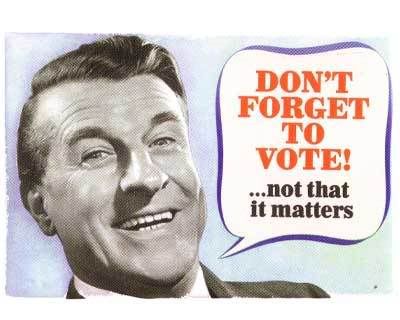
VOTE OR DIE!


As I made my way over to the Puff Daddy special today, a sketchy-looking fellow with pseudo-dreadlocks yelled a question my way: "Have you voted today?" I told him I had not, and he warned me that if I did not vote, "we won't win."

I intend to vote tomorrow, although it unfortunately means riding up to Mason, Ohio with a friend who plans on spending several hours at home with his family. But despite this obstacle, I feel as if I should vote. I care about what happens to the world, and so I care about voting and hopefully thus directing the world in some direction. I have paid too much attention to this campaign to not do anything. But can I do anything? Does one vote matter?

- - - - - - - - - - - - - - - -

My shoes are starting to leave chalk footprints on the carpet of my room. I see the word “vote over a dozen times on the walk from my dorm to class in the morning. Someone on this campus really, really wants me to vote. Still, as John and I sit here chatting about the big day tomorrow, we can’t help but play devil’s advocate. No matter how loudly the sidewalk screams, “VOTE OR ELSE!” we can’t help but wonder…or what? What is the significance of our two little votes?

And yeah, yeah, I hear you. “Ohio is a swing state! We’re crucial to this election!”

Well, what about me? I’m an Indiana voter. Is my vote worth anything?

- - - - - - - - - - - - - - - -

So there you go, the call to exercise your civic duty and the voice of doubt.
Forty-four minutes til the big day kicks off. See you at the polls?

Thursday, October 30, 2008

Because my religion says so...

GOD WILLS IT! This phrase along with many others like it have been spoken throughout history as a means of justification for peoples actions. People have always used religion as a reason for what they do, why they believe one thing over another, and to influence others. Whether or not there is legitimacy behind using religion as justification will be disputed until religion ceases to exist on Earth.

People have used religious reasoning for both positive and negative actions in every corner of the world. Crusaders used the line "God Wills It" as a reasoning for their actions against others throughout the crusade. It seems inappropriate to allow religion to be used as such a tool to justify the hurting of others. So therefore should we not accept religious reasoning in fear that it would be used to harm others?

While on the other hand we have examples such as Mother Teresa who's actions to help others were spurred by religious reasoning as well. Of course it is completely acceptable to allow someone to use religious reasoning if they are helping to care for the less fortunate, right?

Then we have unusual cases such as that of Muhammad Ali; who used his religion as a reasoning to not participate after being drafted for Vietnam. I understand that he wouldn't want to have to go to war, I wouldn't either, but as a citizen of the United States shouldn't he be required to serve. If not then why isn't everyone giving a religious justification for not participating. Yes, the US is known for its religious freedom but doesn't this under mind the US by saying that one persons religion is above our laws?

Ideally most of us would probably say that its O.K. to use religion as a justification to help others, while disapproving using religion to justify negative acts against others, but the world doesn't work like that. So I have two questions for you.
1. Does religious justification sit above the laws of the country that we live in?
2. If you had to choose one way or the other would you A) Accept the continued use of religion as a justification for BOTH positive and negative uses; or B) No longer accept religion as a justification for either and see what else motivates peoples actions.

I'll be the first to answer my questions.
1. As much as I would not wish to be or wish upon anyone else to be drafted I would accept that I am required to serve the country whether I like it or not. I think that if you allow people to begin to use religion as an excuse then the government would ultimately become a puppet of religion. Once one religion is on top the idea of religious freedom would probably begin to disappear and replaced with the top religions beliefs.
2. I would choose for religion as justification to be done away with. Let people give their other reasons for the actions that they perform whether good or bad. Religion shouldn't be used as a shield to hide behind when you can not give better reasons for your actions.

Wednesday, October 29, 2008

Has Humanity Outgrown Religion?

First off, please understand that this question has very little to do with the existence of God or the correctness of any religion. Although you may feel compelled to answer with something like; "we must have public churches and open religious ceremonious because God tells us so," that limits the true scope of the question. What I am really putting into question is whether humanity still needs the common ground of God (any God, any higher power) to stay connected and maintain rules.

Starting with the first civilizations in Mesopotamia, humans have answered the unanswerable questions of the Earth and the Universe with the idea of a higher power of God. This understanding of God made people feel obliged to build massive pyramids and temples, have intense religious ceremonies, and come together to worship and even give sacrifice. The scholars of the time or "Prophets" would write stories that included valuable lessons about how to live and interact with each other, and these stories would become divine laws that the rulers would enforce on all citizens.

It is clear that organized religion has had a huge impact on humanity since those times. Hell, the crusades would not have been possible without God to unify the forces! Since people would all have to leave their homes and go to worship, a sense of community was formed amongst the people and a common ground was established amongst the entire race. Most religions contain a very similar set of values, and these values made clans change from barbaric to civilized societies. In a time of slow communication and highly separated groups of people, organized religion humanized the world.

But, is religion still humanizing the world? Does it still bring us closer together, or draw us farther apart? We now have places like India and America where communication and transportation have allowed diverse groups of people to feel connected and understand the laws even over massive areas of land. People of any religion are able to get along and obey the laws of the new ruling G, Government. Where does organized religion fit in here? Since the 'religious' value system is nearly universal, wouldn't it make more sense to teach these values to everyone in schools and thus not have the need for separate religious sects? It seems that nowadays, organized religion only creates division that leads to war and oppression. We have proven that we can get along and maintain laws without religion. Why not take it a step further and let everyone in?

Sunday, October 26, 2008

More on California's Prop 2

From the New York Times magazine:
Peter Singer, a professor of bioethics at Princeton University and a leading figure in the animal rights movement, compares Proposition 2 to Barack Obama’s presidential campaign, calling Proposition 2 the “other historic ballot this November.” If it passes, it would affect more animals — almost 20 million — than any ballot measure has in U.S. history.
Because California is the largest agriculture state in the country, and often a trend-setter on social issues, the ballot is a bellwether for farm-animal-welfare reform nationwide. Many experts predict that if Proposition 2 becomes law it will create a ripple effect, putting pressure on other states to pass similar reforms and pushing major food corporations to go crate-free and cage-free.

Thursday, October 23, 2008

Public Smoking Ban=Modern Savior!!!!

I[Sarah Oldham] am repulsed by even the slightest hint of smoke. Not only does it reek, but so many pictures and facts bombard my mind. I recall the speakers who came to my grade school with holes in their neck, having to talk through a robot-sounding box pressed up to their vocal chords. I think about my great uncle and aunt who died from cancer due to extensive smoking. I also think of the pictures from my mom’s nursing books; pictures of patients with amputated toes and wounds that won’t heal because of their poor arterial blood flow. I think that smoking is one of the stupidest things a person can do to themselves, especially young adults and teenagers because we have been educated on the subject so extensively. Several of my friends and distant family members are smokers, and they are strongly against the newly popular laws forbidding smoking inside public places. I am a huge fan of this law; if people wish to slowly kill themselves, they are free to do so, but I do not want to breathe in their harmful second-hand smoke while trying to enjoy a meal or a game of bowling with my family.

Once again, I agree with Sarah. :-) Smoking is extremely repulsive. I simply can't see why anyone would want to indulge in "cancer sticks". They're so intensely harmful it's hard to imagine anyone would want to be subjected to it. My grandmother used to smoke 3 packs a day and died of lung cancer before I was even born. The addiction is frightening, she knew she was dying, but she continued to smoke until the day she died. It's amazing that something so small can take away a life, much less many others' lives. I believe that the law banning public smoking is one of the most genius decisions ever made. Applause for the government who finally decided on a way to potentially save millions of lives! It helped to calm the selfishness; for once, awareness was raised to bring the harmful effects on non-smokers to the forefront. I have to say, I'm much happier knowing that I can enter into a restaurant without dying a little.

What are your views on smoking? What do you think about the public smoking ban? Do you think public smoking could have been handled in a different way?

Gay Marriage: Is It Right?

Over fall break, I [Sarah] was sitting with my dad and grandma, watching the news. When a reporter commented on the new gay marriage laws passed in Connecticut, my grandma went on a rant clearly stating her disapproval and how much “these people” sickened her. My dad was quick to agree, he brought up why these laws were against our religious views and about how they are all sinners; ‘marriage is meant to be shared only between man and woman, nothing else.’ But it wasn’t that they solely were against the marriage of same sex couples, but they were criticizing them being open about their ways and being together at all. I didn’t know how to react, so I was left to sit there. I knew I couldn’t voice my opinion without them verbally attacking my views. I have a somewhat in-between opinion; I don’t believe that the government should have the power to prevent civil union between same sex couples, but I do not think that they should be able to be united by marriage within the church. Gay couples do have the right to be happy and be together, but I have been raised and taught (Catholic schooling for 13 years) that it is against my religion as well as some others.

I[Whitney] would have to say that I agree with Sarah on this issue. I also was raised to be a devout Catholic, and even though I'm open to considering all situations, I can't possibly give up the morals that my religion says I should believe. I believe that love is love, and I believe that a person can't choose who he or she loves, even if it does mean that the significant other is of the same sex. I believe that marriage is a sacred union, and yes, the government has no right to interfere. But in the sacred confines of a church, and also due to the separation of church and state, the church, not the government, has a right to choose who it will marry. I believe that homosexuals should not get to challenge the church's wishes, why should anyone get to challenge beliefs that are specifically laid out in a religion's guidelines? A civil union is acceptable, but let's take a dive into reality.

However, considering that America accepts all religions, do you think that we should grant gays the right to be united by marriage in the church? Do they have the right?

Monday, October 20, 2008

Saturday, October 18, 2008

Harry Potter or Harry Plotter?

This is really Scott Gula. My account wouldn't let me post for some reason, so Tyler let me post through his account. In no way do the ideas presented in this post reflect the views of Tyler.

Here's a story about a women named Laura Mallory, from Loganville a suburb of Atlanta, Georgia who is on her second crusade to remove Harry Potter from school libraries. She says Harry Potter is trying to indoctrinate children as wiccans or practitioners of religious witchcraft. She claims the reason behind violent acts such as school shootings, are due to the evil promoted by books such as Harry Potter. According to her, these actions wouldn't happen if children read the Bible instead.

This could be the most ridiculous thing I have ever heard. Why is it that fanatical Christians think that Harry Potter is corrupting their children? I don't understand how people can think these books are attempting to turn their children into witches. The intentions behind Harry Potter are not those of Wiccan propaganda, it is the story of a woman and her child trying to make enough money off her books to survive. Mallory should realize that people aren't stupid enough to believe in magic and spells. Kids these days don't read Harry Potter to learn the ingredients to polyjuice potion or to find out how to defeat a dementor, they read the books because they are thrilling works of literature.

If anything the Harry Potter books have done more good than bad. Kids these days don't read enough, but because of Harry Potter an entire generation of children have been inspired to explore the world of literature. Kids stop watching TV and playing video games to read these books. And besides even if a child wants to believe in magic and wizards, what's so bad about having a little imaginaion?